Turbine in Sweden. Experts in Munich. A Remote Alignment Challenge Solved With RotAlign Live Trend
Summary
A German steam turbine manufacturer planned to replace a gear coupling with a much heavier flexible metallic disc coupling on a 24 MW turbine operating in Sweden, between the generator and the gearbox. Before approving the change, the manufacturer’s insurer required verified alignment specifications to confirm if the added mass would influence the target alignment specifications between the gearbox and generator.
Using the RotAlign tool’s Live Trend feature and Fluke Cloud connectivity, experts in Munich were able to remotely monitor real machine movement through cloud-based measurements, giving both the insurer and the turbine manufacturer clear, validated data to move forward confidently.
- Remote Live Trend monitoring captured genuine thermal and positional changes caused by the heavier flexible metallic disc coupling.
- Cloud-based data transfer allowed Munich-based experts to analyze and validate alignment data without being on site.
- The measured values made it possible to establish new alignment specifications, thereby providing assurance to both the turbine manufacturer and the insurer that the turbine train would remain within alignment tolerances during operation with its new coupling.
Introduction
A German steam turbine manufacturer was preparing a mechanical upgrade on a 24 MW turbine installed in Sweden. The plan involved replacing the existing gear coupling, installed between the generator and the gearbox, with a larger, heavier dry flexible metallic disc coupling (the weight increase is 25% to 40% depending on the torque to be transmitted. Because this change could influence gearbox alignment and generator behavior once the unit started running, the insurer required a deeper understanding of the machine’s movement during operation before approving the modification.

Example of gear couplings (left) and disc couplings (right); Source Photos: RENK Brand
The Challenge
All rotating machinery shifts position as it warms up. Temperature changes, pipe forces, and rotor dynamics can cause vertical, horizontal, and angular movement between connected components.

Because these shifts happen during run-up and operation — not when the machine is cold — the insurer needed visibility into the turbine’s positional changes under real operating conditions.
To provide a reliable assessment, the project needed a measurement approach capable of calculating the two flexible planes of the new coupling and producing accurate alignment specifications.
Implementation
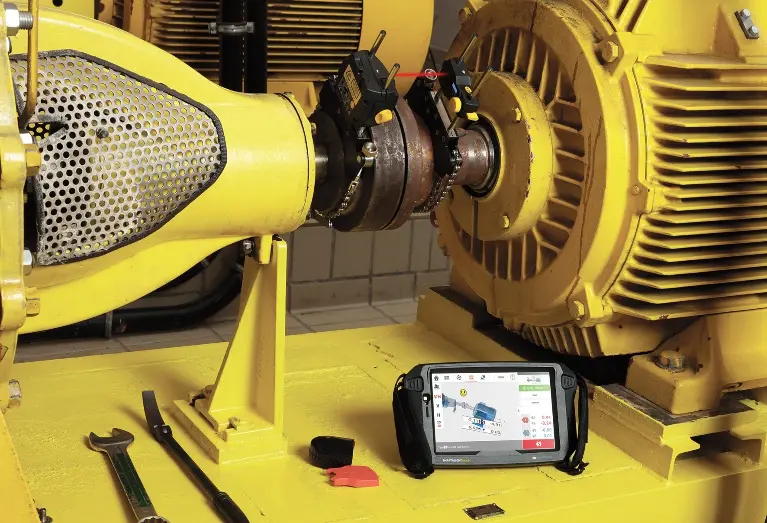
To measure how the generator-gearbox moved with the disc coupling, the team used RotAlign Touch with its Live Trend feature. Live Trend continuously records offset and angular changes in vertical and horizontal positions during run-up, operation, and coast-down, making it possible to see the machine’s thermal movements rather than relying on cold or warm snapshots.
Onsite Setup in Sweden
Technicians from the turbine manufacturer installed RotAlign Touch sensors on the turbine using magnetic brackets, making placement quick and straightforward. Fluke engineers in Munich verified the setup remotely via photos and communication checks. RotAlign Touch was then configured with internet access so measurement files could be uploaded to the Fluke Cloud.
Once everything was in place, the Live Trend measurement session was started and allowed to run continuously. About every two days, a technician paused the measurement, saved the results, uploaded the file to the cloud, and restarted the session. This process created a continuous timeline of machine movement without disrupting turbine operation. The Live Trend measurement lasted continuously for 23 days, during which the team observed changes in alignment during the multiple test phases.
Example of installation with a magnetic bracket:

Remote Review in Munich
Fluke engineers accessed each cloud-uploaded file with ARC 4.0. alignment and condition-monitoring analysis software.
After each review cycle, the engineers shared graphs and data files with the insurer, providing a clear, ongoing view of how the new coupling performed during real operating conditions.
Results
The Live Trend data showed that the disc coupling behaved as expected in horizontal once the turbine reached operating condition.

The Live Trend data showed some discrepancies with the expected values in vertical.

Live Trend allowed the experts to conclude:
- Generator vertical movement: +0.07 mm (vs. +0.20 mm target)
- Gearbox horizontal expansion:54 mm (vs. 0.53 mm target)
- Additional finding: Live Trend identified a light vertical angular movement of +0.09 mm/200 mm, which the turbine manufacturer had not identified.
Across multiple measurement intervals, the machine train displayed stable, predictable positional changes from startup through steady operation. With each file uploaded from the turbine site, Munich-based engineers confirmed that the turbine’s actual thermal movement aligned more or less with expectations and remained within safe limits. The insurer and manufacturer received complete, standards-aligned documentation, giving them the confidence to move forward with the coupling upgrade without requiring an on-site specialist.
Conclusion
This project demonstrates how RotAlign Touch features such as Live Trend, ARC 4.0, and Fluke Cloud connectivity can deliver a complete alignment assessment remotely. By capturing real machine movement and analyzing each dataset in Munich, the team was able to evaluate a turbine in Sweden without an on-site visit. This allowed savings on travel expenses and unnecessary on-site standby hours. The result is a clear demonstration of how remote alignment diagnostics can support critical decisions, reduce logistical friction, and provide deeper visibility into machine behavior, especially for large, high-value rotating assets.
Business Impact
For the Insurance Company & OEM
– Verified alignment without sending a specialist to the site
– Confidence that the heavier spacer coupling remained within acceptable limits
– Timestamped documentation suitable for audit and engineering review
For the Turbine Operator
– No interruption to turbine operation during measurement
– Clear insight into real thermal and positional behavior
– Assurance that the machine train remained stable with the new coupling