Laser Shaft Alignment vs Dial Indicators: The Differences and Why They Matter
Aligning rotating equipment is a critical part of proper equipment maintenance, especially since up to 50% of machine failures can be traced back to misalignment. There are a few different ways to perform alignments, but the most common methods use dial indicators or laser alignment tools.
Dial indicators have been used for alignments for over a hundred years. And while laser alignment tools are a more recent invention, both dial indicators and laser alignment tools are still used regularly.
This article will give practical guidance to help maintenance technicians and managers decide between using traditional dial indicators or newer laser alignment methods and provide insight about the pros and cons of each method.
Table of Contents
- Dial Indicators: The Older, Time-Consuming Alignment Method
- Laser Alignment Tools: A Faster, More Precise Alignment Method
- Key Laser Alignment Features To Simplify Every Alignment Job
- The Final Verdict: Laser Shaft Alignment vs Dial Indicators
Dial Indicators: The Older, Time-Consuming Alignment Method
Dial indicators are a longstanding method for performing shaft alignments. One key benefit of dial indicators, and a reason many organizations still rely on them, is that they are a lower-cost alignment tool. And for many companies striving to keep maintenance costs low, dial indicators can seem like a serviceable, money-saving alignment tool option.

Rim and Face Method Using Dial Indicators
However, dial indicators add unnecessary complexity and time to the alignment process, ultimately hurting technician productivity and driving up labor costs as employees spend extra time performing alignments. Here are some of the limitations of dial indicator shaft alignment:
- Requires pre-alignment: To use a dial indicator effectively, your team must perform a pre-alignment with a straight edge before dial indicator alignment begins. Technicians will also need to perform soft foot checks to ensure the dial indicator can take correct readings.
- Difficulty installing: Correctly installing dial indicators on the shafts can be challenging. And even after the installation is complete, dial indicator shaft alignment requires multiple installations for measuring different types of misalignments. For example, after the pre-alignment, technicians have to measure alignment in four different ways (horizontal angular misalignment, horizontal parallel misalignment, vertical angular misalignment, and vertical parallel misalignment). Each measurement requires properly positioning the indicator, measuring, adjusting, and then remeasuring to confirm alignment.
- Measurement challenges: The dial must be read visually, but certain machine setups can make it challenging to read the indicator in every position, requiring strategic use of mirrors or other tools in order to read measurements on the dial indicator. This can lead to errors as technicians are often working in dark, cramped environments and may make mistakes.
- Manual recording and calculations: Dial indicator readings must be read and recorded manually. Any calculations must also be done manually, making them prone to human error.
- Operator skill limitations: Technicians performing alignments with dial indicators must have a deep understanding of how to read the indicators and what information the indicator is telling them about how to adjust the machine to achieve alignment. The skill level of individual technicians can influence alignment results.
- Limited accuracy: Even the most skilled technician is limited by dial indicator accuracy. Some factors impacting accuracy are:
- Sagging indicator brackets: Even tiny amounts of sagging can throw measurements off and impact the reliability of the alignment
- Low resolution: Each reading can have a rounding error of up to 0.005mm, which can add up to a 0.04mm error in the final result.
- Sticky dial hands: Tapping the indicator is sometimes required in order for the needle to settle, which can impact the measurement.
So, while the tool itself is less expensive, dial indicator shaft alignment is a challenging, time-consuming process, and even the most experienced and well-trained technician can make small errors that prevent precision alignment.
Laser Alignment Tools: A Faster, More Precise Alignment Method
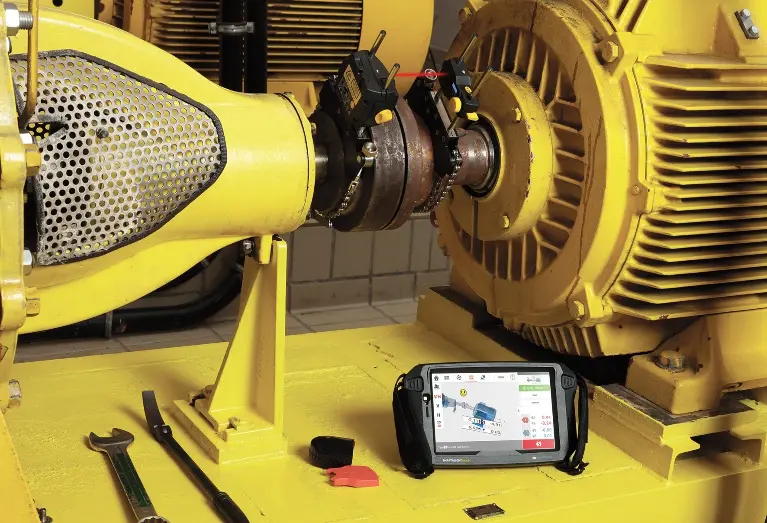
Laser alignment tools represent a significant advancement in shaft alignment technology, offering precision, speed, and ease of use that surpass traditional methods like dial indicators. These systems use laser beams and sensors to measure alignment with high accuracy, streamlining the process and reducing downtime. For organizations that prioritize efficiency and precision, laser alignment tools are often the preferred choice.

Here are some of the key benefits of laser alignment tools:
- High precision and accuracy: Laser alignment systems deliver measurements with exceptional accuracy, to within 0.001 mm. This precision minimizes errors and ensures machinery operates within optimal alignment tolerances, reducing wear and extending equipment lifespan.
- Simplified setup and operation: Unlike dial indicators, laser alignment tools require minimal setup and don’t require pre-alignment. The laser emitter and sensor are mounted on the shafts, and the system automatically detects misalignments. Many systems guide technicians through the process with user-friendly interfaces, reducing the need for extensive training.
- Real-time feedback and adjustments: Laser systems provide real-time data on a digital display, allowing technicians to make adjustments and immediately see the impact. This eliminates the need for multiple measurements and repositioning, speeding up the alignment process.
- Automated calculations and documentation: Laser alignment tools automatically calculate misalignment values and suggest corrective actions, eliminating manual calculations and reducing human error. Many systems also generate digital reports, simplifying documentation and compliance with maintenance records.
- Versatility across applications: Laser alignment systems can measure various types of misalignments (horizontal, vertical, angular, and parallel) in a single setup. They are also adaptable to different machinery types and sizes, making them suitable for diverse industrial applications.
- Reduced downtime: The speed and efficiency of laser alignment tools significantly reduce the time required for alignment tasks. This minimizes equipment downtime, boosts technician productivity, and lowers labor costs.
- Improved accessibility: Laser systems often include wireless connectivity, allowing technicians to operate them from a safe distance or in cramped, hard-to-reach areas without relying on mirrors or manual readings.
While laser alignment tools typically involve a higher initial investment than dial indicators, their precision, speed, and ease of use make them a valuable, cost-effective solution in the long term.
Key Laser Alignment Features To Simplify Every Alignment Job
In 1984, Pruftechnik introduced the world’s first single-laser optical shaft alignment system, OptAlign. This laser alignment tool set a new benchmark in alignment technology, and Pruftechnik innovations have continued improving and simplifying alignment technology in the decades since. Now, laser alignment tools from Pruftechnik also include ShaftAlign and RotAlign, each purpose-built to eliminate common alignment errors and achieve precision shaft alignment faster than dial indicators.
LiveMove is a feature that enables aligning equipment while the laser alignment system is still in place. It allows users to see real-time feedback on the display screen, letting users know once alignment within tolerance has been achieved.
Another key feature from Pruftechnik is LiveTrend, which records the thermal growth of a machine while it is running. This feature enables accurate alignment that takes thermal growth into consideration during the alignment process, so that precision alignment can be achieved even after thermal growth occurs — a task that is impossible with dial indicators.
Pruftechnik alignment tools are intuitive and easy to use. They include digital workflows with step-by-step instructions, so technicians can achieve alignment whether they’re alignment pros or using an alignment tool for the first time. They automatically account for common problems like coupling backlash, limited range of motion, and vibrations from surrounding equipment, and cloud connectivity allows for easy, accurate recording.
Pruftechnik laser alignment tools and expert alignment services allow you to achieve precision alignment quickly. To find the best laser alignment system for your needs, discover our comprehensive range of laser shaft alignment solutions.
The Final Verdict: Laser Shaft Alignment vs Dial Indicators
When comparing laser shaft alignment and dial indicators, the choice often comes down to balancing initial costs with long-term efficiency and precision. Dial indicators, while less expensive upfront, require more time, skill, and manual effort, which can lead to higher labor costs and potential errors due to their complex setup and limited accuracy.
In contrast, laser alignment tools, though more costly initially, offer superior precision, speed, and ease of use, significantly reducing downtime and maintenance costs over time. For organizations prioritizing accuracy and productivity, laser alignment systems are the more effective solution.